
April 9, 2026
TL;DR:
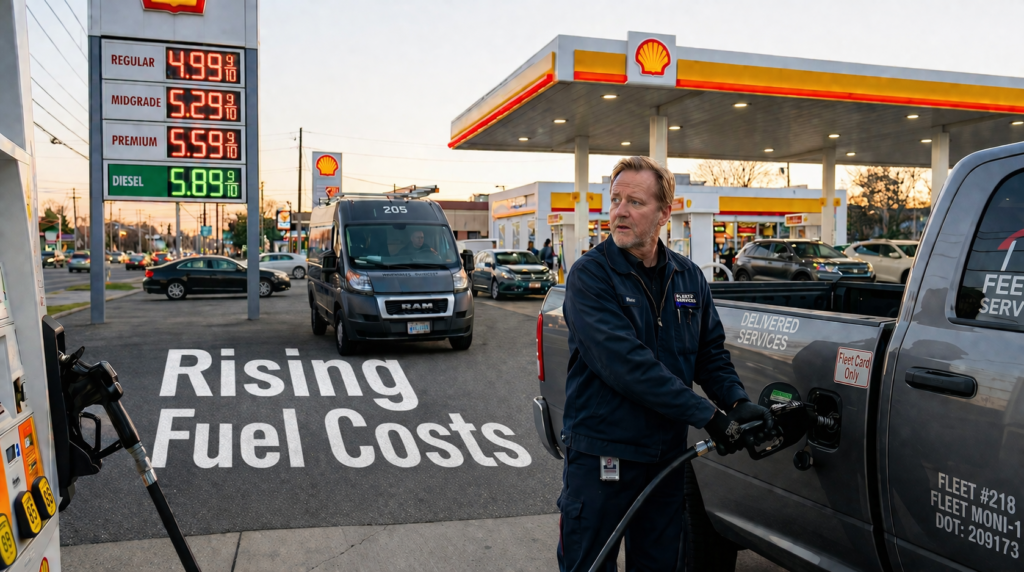
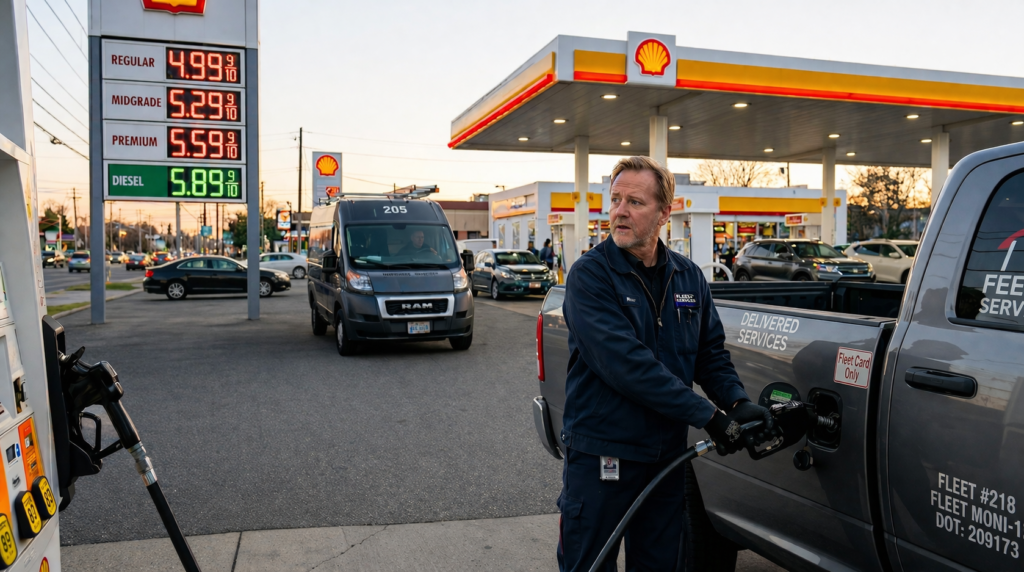
Fuel costs have spiked sharply over the last month. And if you’ve been watching the news lately, you already know the current outlook isn’t offering much comfort. Global supply constraints, crude oil disruptions from the Middle East, described by the International Energy Agency as the largest supply disruption in the history of the global oil market, and ongoing transport volatility have pushed diesel and gasoline prices to levels that most service fleet operators weren’t budgeting for.
The questions most operators are currently wrestling with are:
“Do we raise prices or introduce fuel surcharges? If so, by how much?”
But the more important questions are:
“How are our customers feeling right now?”
“Could a price increase put them at risk?”
“What could the longer-term impact be on our business?”
These are the questions that separate a panicked response from a smart one.
Fuel prices will eventually stabilize. The question is: which version of your business comes out the other side?
Your customers are watching the same news you are. Their costs are rising too. And the moment you send a price increase notice, you may solve a short-term problem, but you’re testing every bit of trust and goodwill you’ve built with your customers. Customer satisfaction should be a core factor in how you run your business. In this current fuel crisis, while other operations are fixated on the first question, let this be the turning point that strengthens yours. While others unravel, you can come out of this crisis stronger than ever.
It’s tempting to treat a fuel surcharge as a simple, logical move. Fuel costs go up, prices go up. That’s business. But consider what’s already happening in the broader market before you send that notice.
The giants of the shipping world, like FedEx and UPS, for example, both have their fuel surcharges adjusted weekly, tied directly to national diesel benchmarks. They can do this because their scale and brand recognition make it hard for customers to walk away. But you’re not operating with the same leverage FedEx has. If you pile on with a price increase of your own, you may not be the first to raise costs on your customers, but you could easily be the one that pushes them over the edge.
So what actually happens on the customer’s end when you raise prices? Some will accept it. Many will quietly start shopping around. A few will leave without saying much at all; they’ll just be gone by the next renewal. Research from Qualtrics puts the cost of that in stark terms: acquiring a new customer costs up to five times more than retaining an existing one. And according to CustomerGauge’s State of B2B Account Experience report, the logistics industry carries one of the highest customer churn rates of any B2B sector, at around 40% annually. That number should give every fleet operator pause before reaching for a surcharge as a first move.
Because here’s what makes the churn problem particularly painful for service fleets: when a customer leaves, it doesn’t just cost you their contract. It costs you route density.
Every stop you lose on a route makes the remaining stops more expensive to service. Your vehicles are still driving the same corridors, but now with fewer jobs to justify the distance. The economics of that route quietly deteriorate, and if you’re not watching carefully, you end up spending more per stop than you were before you raised prices in the first place.
This is the compounding problem nobody talks about when fleet operators reach for a price increase as their first response. The increase feels like protection. But if it drives even a modest amount of churn, the resulting route density loss can leave you worse off than if you’d absorbed part of the increase and kept your customer base intact.
So what should you actually do?

Here’s an uncomfortable truth for most service fleets: a significant portion of the driving your fleet does every day is waste. The American Transportation Research Institute (ATRI) 2025 industry benchmark identifies that “deadhead” or empty mileage now accounts for an industry average of 16.7%. For specialized delivery and service operations, this figure frequently trends higher, meaning nearly one out of every five miles driven is non-revenue waste. This stems from backtracking, poor stop sequencing, and routes that haven’t been revisited in months.
Before you ask your customers to absorb higher costs, it’s worth asking honestly whether you’ve actually eliminated the fuel spend you have full control over. Because if you raise prices while quietly running routes that could be tighter, and a competitor is doing that same work more efficiently, they now have room to undercut you. And your customers have a reason to listen to them.
Tightening your routing isn’t just a cost-saving exercise. Right now, it’s a competitive positioning decision. The fleets that use this period to get operationally leaner are the ones who’ll be able to hold pricing, win new stops, and build the kind of route density that makes their operation genuinely hard to displace.
This is not the same as wasted mileage. The first problem is route inefficiency. This is route economics. Most service fleets plan routes by sequencing stops in a reasonable order. But there’s a more important question: are the right stops even on the right routes in the first place?
Stop density is how many jobs your vehicle completes per unit of distance driven. The higher your density, the lower your fuel cost per job. And improving it doesn’t cost your customers anything. It actually improves their experience, because tighter, better-clustered routes mean more reliable arrival windows and fewer late technicians.
It’s also a growth strategy. Win one or two new customers in a corridor you’re already running, and your fuel cost per job across that entire route drops. You’re covering the same distance with more revenue attached to it.
The flip side is just as important. Lose a handful of customers in a key corridor due to a price increase, and your stop density falls. Your vehicles cover the same ground for fewer jobs, and your fuel cost per stop actually goes up. The price increase that was supposed to protect your margin quietly works against it.
Doing this manually is possible for a fleet of a few vehicles, but as your operation grows, accounting for time windows, service durations, and real-world traffic makes consistent optimization very difficult without the right tools. That’s where route optimization software like Scheduled Routes earns its place, not just for sequencing stops, but for ensuring your routes are always built around the most cost-efficient clustering of your current customer base.
There’s a version of “routing and scheduling optimization” that’s really just compression: squeezing more stops into the same window, cutting service times to the bone, building a plan that only works if everything goes perfectly. That’s not real optimization. That’s just pressure with a prettier name.
The schedules that actually hold are built around how your operation genuinely runs. Realistic service windows. Time commitments your team can meet. Sequences that account for the real shape of the day, not an ideal version of it. When you build that way, one job running long doesn’t cascade into a string of late arrivals and frustrated customers.
This matters more than it might seem right now. Customer loyalty isn’t just about price; it’s about reliability. A customer who trusts that you’ll show up when you said you would, service them properly, and communicate if something changes, is a customer who’s far less likely to take a competitor’s call. Operational reliability is a retention strategy. And in a high-cost environment, retention is margin.
That’s exactly what a purpose-built route optimization tool is designed to support. Not just tighter stop sequences, but schedules grounded in how your operation actually runs, with the flexibility to adapt when the day doesn’t go as planned, so your customers never feel the difference.

Every fleet in your market is facing the same fuel problem. Not every fleet will respond the same way. Some will push the cost straight to customers. Others will use this stretch to run tighter routes, improve stop density, and remove inefficiencies that have been hiding in plain sight. The second group does more than protect margin. It puts itself in a stronger position when the market settles.
The window to act is now, because the market is always actively rebalancing. Customers who are dissatisfied are starting to look around. Routes are being won and lost. The fleets making decisions right now are the ones who’ll be positioned well when conditions stabilize.
A route optimization tool like Scheduled Routes is what makes this practical. Not in theory, but in the actual workflow your fleet operators and dispatchers run every morning. It sequences stops intelligently, adapts when the day changes, and builds schedules grounded in reality rather than optimism. The result is less fuel burned, more consistent on-time service, less dispatcher stress, and a daily operation that doesn’t require a price increase to stay profitable.
If that’s the operation you want to be running, one your customers trust enough to stay with even when it would be easy to leave, this is the right moment to build it.
DDS Wireless Inc. develops routing and scheduling technology for vehicle-based operations across North America and Europe. Our Scheduled Routes platform is a route optimization solution that helps fleet teams plan and adjust multi-stop routes with real operational constraints in mind.