
March 9, 2026
TL;DR
2026 fleet costs are rising from many directions: maintenance, fuel, insurance, labor & compliance, tariffs and global uncertainty.
The same workload costs more every year, so margins quietly shrink, and 2026 is the most volatile year yet.
You cannot control the market, but you can cut mileage, reduce replanning, and protect vehicle uptime.
A better route optimization strategy with proper tools is the key to solving this cost creep and protecting margin in 2026.
When operating costs quietly eat into margins
If your business relies on vehicles to deliver, visit, pick-up, drop-off, or move people on a schedule, you have probably noticed the same pattern. It’s a constant stream of re-routing, rescheduling, repairs, higher-than-expected contract renewal rates and premiums, and driver overtime to make up for the tight planning. Each of these disruptions feel routine, but over months you start wondering how the business got harder when the work volume never really changed.
Pressure is coming from several directions at once, and it tends to creep up on you. You don’t notice it in a single month. You notice it after a couple of quarters. The numbers look tighter than they should. In 2026, those costs rise faster. The causes are mostly the same:
Each of those has its own story. Together they explain why running a service fleet feels even harder in 2026, even for operators who are doing everything right.
Maintenance costs: a quiet cost squeeze
Keeping a fleet road-ready has gotten noticeably more expensive. In 2025, motor vehicle maintenance and repair rose 5.4% according to BLS CPI data, roughly 2x the inflation rate. The percentages sound small. Across a fleet, they compound fast. Over a year, the total is painful. Looking ahead, professional forecasters expect CPI inflation between 2.8% and 3.2% in 2026 , which suggests the baseline pressure is not going away.
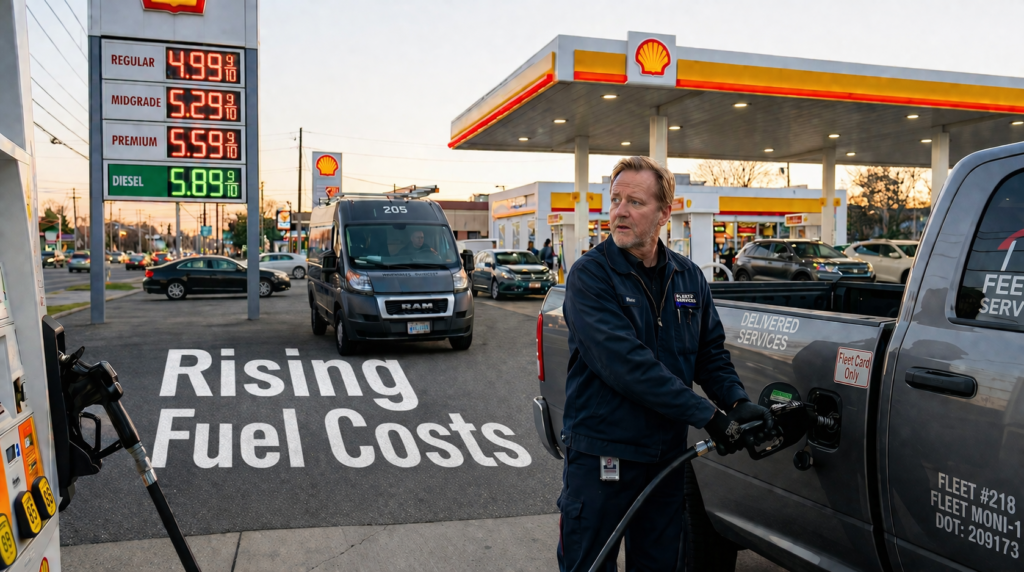
Fuel costs are also a growing concern for 2026 amidst the uncertain global economic and geopolitical climate. The EIA’s updated baseline projection now puts average U.S. retail diesel at $4.12 per gallon for the year, a significant increase from previous estimates of around $3.43 per gallon.
While not at record highs, this figure represents a significant operational cost that cannot be ignored. The EIA emphasizes that geopolitical volatility and supply constraints make these prices unpredictable; the practical point is that at $4.00+ per gallon, every unnecessary mile driven is a direct and substantial hit to the bottom line.

Insurance keeps getting tougher for service fleets because claim severity keeps rising. CCC’s 2025 Crash Course data puts the average total cost of repair at about $4,768 through 2025, with repair costs still climbing into 2026 as calibrations and complexity become more routine.
Premiums follow that math. NAIC’s 2025 analysis, citing the CIAB commercial market report, shows commercial auto premium rates up 8.8% in 2025, extending 56 straight quarters of increases. That kind of run does not produce relief in 2026. As reported in the Claims Journal, these trends produce tighter underwriting, higher deductibles, and more scrutiny of fleet safety and controls.
Labor and compliance costs: the hidden multiplier
Labor costs are rising, but the bigger surprise for many service fleets in 2026 is compliance. State wage and hour rules are tightening. More roles are losing exempt status. That forces raises or reclassification. It also adds overtime, break, and time tracking.
Compensation costs for civilian workers rose 3.4% over the year ending December 2025, according to the US Bureau of Labor, while exempt salary thresholds are climbing in parallel. To put some numbers to some context, California‘s minimum salary for exempt employees rose to $70,304 in 2026, and Washington State‘s equivalent threshold climbed to $80,168 for the same year. For fleets operating across state lines, the same job title can carry different compliance obligations depending on where the work happens.
When roles get reclassified, the cost isn’t just overtime. It’s everything around it: tighter timekeeping, more approvals, more documentation, and more back and forth every time the day runs long. A poorly built schedule used to be a fuel and overtime problem. In 2026, it’s a compliance workload problem too.
Recent trade policies in the US shifted from a slow burn to a potential firestorm. Following the February 2026 Supreme Court ruling that invalidated previous “reciprocal” tariffs, the administration pivoted to a new 15% global import surcharge under Section 122 of the Trade Act. This move was designed to address the trade deficit. While this 15% surcharge is lower than the 25% duties seen in 2025, it applies much more broadly across global supply chains and reaches into the transportation-related industries.
For fleet operators, the effects are now a permanent fixture of the budget. Section 232 tariffs of 25% on steel and 10% on aluminum are still in place, keeping the cost of heavy-duty components and vehicle bodies stubbornly high. Expensive parts and rising replacement costs push operators to hold onto older vehicles longer. This means more breakdowns, higher repair frequency, and more exposure to the very costs they’re trying to avoid. This isn’t a temporary spike to costs. It’s the new baseline.
Beyond tariffs, the bigger issue is global uncertainty. Geopolitical tensions, shifting trade relationships, and sudden policy changes can move fuel prices, parts availability, and lead times with very little warning. For service fleets, that means budgeting gets harder and cost projections can break by mid-year.

Three places to start tightening up
You can’t control what the insurance market does next quarter, or what a new tariff schedule does to parts pricing next month. What you can control is how much of that external pressure actually finds its way into your operating costs. Most of the damage that squeezes fleet margins in a tough market comes down to three things: unnecessary mileage, hours burned on rework and replanning, and vehicles that aren’t available when you need them. Get those three under control and the rest becomes a lot more manageable, even when the market isn’t cooperating.
A lot of unnecessary mileage doesn’t come from any single obvious problem. They are a pattern that slowly becomes “normal”: overlapping coverage areas, familiar assignments that ignore geography, and manual sequencing that creates backtracking.
This is exactly where modern route planning and route optimization tools earn their keep. They expose the overlap. They build tighter sequences automatically, and make it easier to assign work based on proximity and timing instead of habit. If you are seeing mileage creep month after month, it is usually a sign that the plan needs more than a quick tweak. It needs an engine behind it. Route optimization tools such as Scheduled Routes are built for service fleets and help teams adapt fast when the day changes.
The fastest savings often come from fewer mid day route rebuilds. When the plan breaks, you pay for it in extra dispatch hours, more customer calls, and overtime.
Most fleets spot the root causes quickly once they track them for a week or two. Stop that consistently run long. Time windows that force impossible sequences. Routes that break before noon.
Two fixes usually move the needle most. First, plan with realistic service times, not best case assumptions. Second, separate required time windows from preferences. When those get mixed, the entire day gets tighter than it needs to be, and one delay turns into a cascade.
This is also where a route optimization engine quietly helps. It is not just about “better routes.” It is about building plans that are feasible in the real world, and easier to adjust without rebuilding everything from scratch.
Less reworking and replanning does not just cut admin hours. It reduces end-of-day panic and rushed driving, which matters in a commercial auto insurance market that is still tightening.
Protecting vehicle uptime
If your fleet skews towards older vehicles, this one deserves real attention. A 2026 benchmark data from Fleetio found that vehicles over ten years old accounted for roughly a third of total maintenance spending while covering barely more than a tenth of total miles driven. That’s a lopsided ratio, and it gets worse the longer those vehicles stay in rotation.
The practical move is to match your most time sensitive work to your most dependable assets. Build enough flexibility into the schedule so a single breakdown does not take everyone else down with it. Spread the workload more evenly rather than running certain vehicles into the ground while others sit underused. Better route planning and scheduling tools can optimize for lower travel time. It can also balance workload across vehicles. That spreads wear more evenly. Tariffs push replacement costs higher. Smarter use of older vehicles can be cheaper than early replacement.

When costs are climbing from five directions at once, the quality of your daily route plan becomes the difference between staying ahead of your costs and constantly wondering where the money went. It is what prevents operational drag from quietly eroding your margin month after month.
The numbers behind routing efficiency speak for themselves. Large carriers like UPS who have invested heavily in route optimization have documented reductions of millions of miles driven annually. It translated directly into lower fuel costs, less vehicle wear, and measurably fewer late deliveries. The math works the same way at any fleet size. Fewer wasted mileage means lower fuel and wear costs. More stable schedules mean less rework and less overtime. Better planning means your team spends less time firefighting and more time actually running the operation.
In a year where fuel costs, repair bills, insurance renewals, and labor compliance are all pushing in the wrong direction, your routing and scheduling process is one of the few things you can genuinely improve without waiting for the market to level out.
DDS Wireless Inc. develops routing and scheduling technology for vehicle-based operations across North America and Europe. Our Scheduled Routes platform is a route optimization solution that helps fleet teams plan and adjust multi-stop routes with real operational constraints in mind. This reduces the hidden costs that stack up across months, like rework, overtime, and avoidable mileage when plans change.